repository​agent
1 required check failing — merge blocked

If it can't pass your pipeline, neither can your agents.

You already bought Copilot, Codex, Cursor, Claude Code, and Devin. They're fast — but they break things, ignore your conventions, and burn review time. We harden the gate every commit already flows through, so anti-patterns can't merge — no matter who wrote them.

Hardening repos for agents on
GitHub CopilotOpenAI CodexCursorClaude CodeDevin
#1429 agent/refactor-auth main Refactor auth module & tidy error handling
opened by  copilot-agent · 4 files changed · +212 −88
buildpassed · 1m 12s
unit testspassed · 3m 04s
typecheckpassed · 46s
lintpassed · 22s
repository‑agent / quality‑gatefailed · 8s Blocked: introduces duplicated logic and bypasses the shared error boundary — violates 2 enforced rules.
Merge blocked Required check must pass before this can merge.
Problem

“We already bought AI coding tools. They're fast, but they break things, waste review time, and ignore our conventions — and now usage is getting harder to control. Make our repo safe and productive for agents.

— the sentence your CTO keeps saying
84%
of developers use or plan to use AI coding tools1
66%
are frustrated by “almost right” AI output1
29%
trust AI accuracy — 46% actively distrust it1
60k+
open-source projects already use AGENTS.md2
Why now

Four forces are colliding inside your repo

Adoption is high, trust isn't

84% of developers use or plan to use AI tools, yet only 29% trust their accuracy and 46% distrust it. The “almost right” PR is now the default failure mode.

The repo is the control plane

AGENTS.md, Codex instructions, and GitHub's file-based custom agents (.github/agents) all point to repo-level guidance becoming standard infrastructure.

Bad context is now a budget line

Copilot's June 2026 move to usage-based billing means failed runs, repeated review loops, and token-heavy agent work hit the invoice directly.

The system beats the tool

DORA's 2025 report: AI amplifies existing strengths and weaknesses, and the gains require control systems around it — not just buying another tool.

The core idea

Don't trust the agent. Trust the gate.

You can't code-review your way out of agent volume, and you can't prompt your way to a guarantee. But you already own the one thing that is a guarantee: the pipeline every commit flows through. Harden it once, and it holds the line against humans and agents alike.
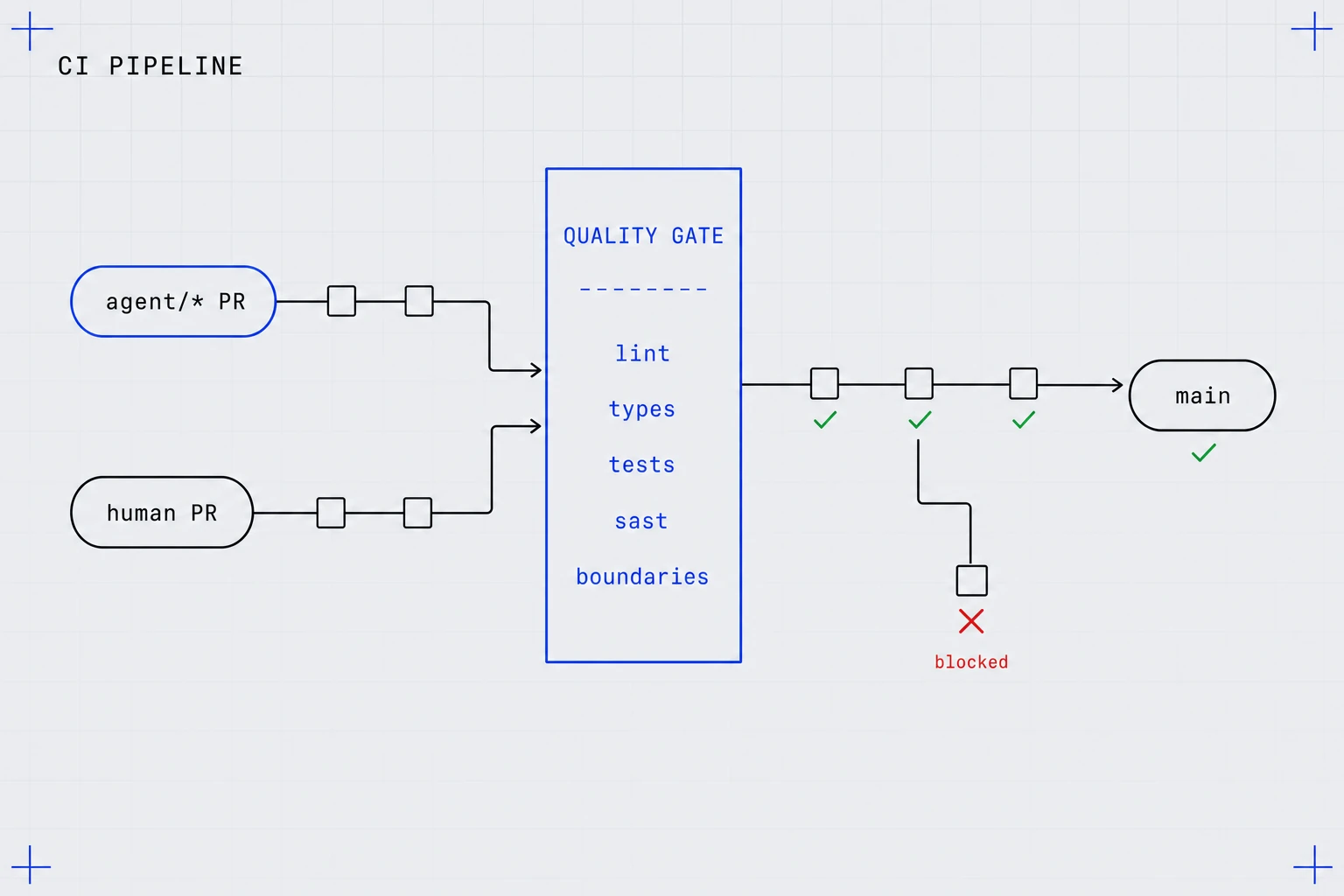
CI pipeline diagram: agent and human pull requests pass through a quality gate of enforced checks; clean commits reach main, a bad one is blocked.
every commit — human or agent — passes the same enforced gate before it can reach main

If an anti-pattern can't pass your pipeline, then an AI's code can't land it either.

45%
of AI-generated code samples introduced a security vulnerability in Veracode's 2025 testing3
↑ churn
GitClear's 2025 analysis finds copy-pasted and duplicated code climbing as AI volume rises4
−19%
experienced devs were slower with AI on familiar code in a 2025 METR study — raw tools aren't ROI5
use what you own

The tooling already exists

Pre-commit hooks, CI checks, linters, type checkers, SAST, coverage gates, branch protection, required reviews. No new platform — we turn the gates you already pay for into enforceable contracts.

executable, not advisory

Rules that block the merge

A convention in a doc is a suggestion an agent can ignore. The same rule as a lint rule, an architecture-boundary check, or a failing test is a wall. We convert your conventions into checks that fail CI.

same bar for everyone

Agents face the human gate

The agent gets no special path. Its PR meets the same required checks your engineers do — so “almost right” fails CI instead of failing in production, and reviewers stop being the safety net.
Why this beats prompting alone: instructions raise the average quality of agent output; gates set the floor. AGENTS.md tells the agent what you'd like; a red pipeline tells it what's non-negotiable. You need both — but only one of them is a guarantee.
Before / after

Same agent. Same repo. Different system.

Before — repo isn't agent-ready

  • No deterministic agent instructions
  • Unclear or undocumented test commands
  • Conflicting setup docs across packages
  • Conventions live in docs the agent can ignore
  • Anti-patterns pass CI and reach human review
  • Senior engineers are the only safety net

After — Agent-Ready Repo Sprint

  • Root + nested AGENTS.md with deterministic guidance
  • Exact install / test / lint / build command map
  • Conventions enforced as executable CI checks
  • Anti-patterns fail the pipeline before review
  • Agents held to the exact same required checks
  • Before/after benchmark proving what's now safe
Where we fit

Not another review bot. Not another agent.

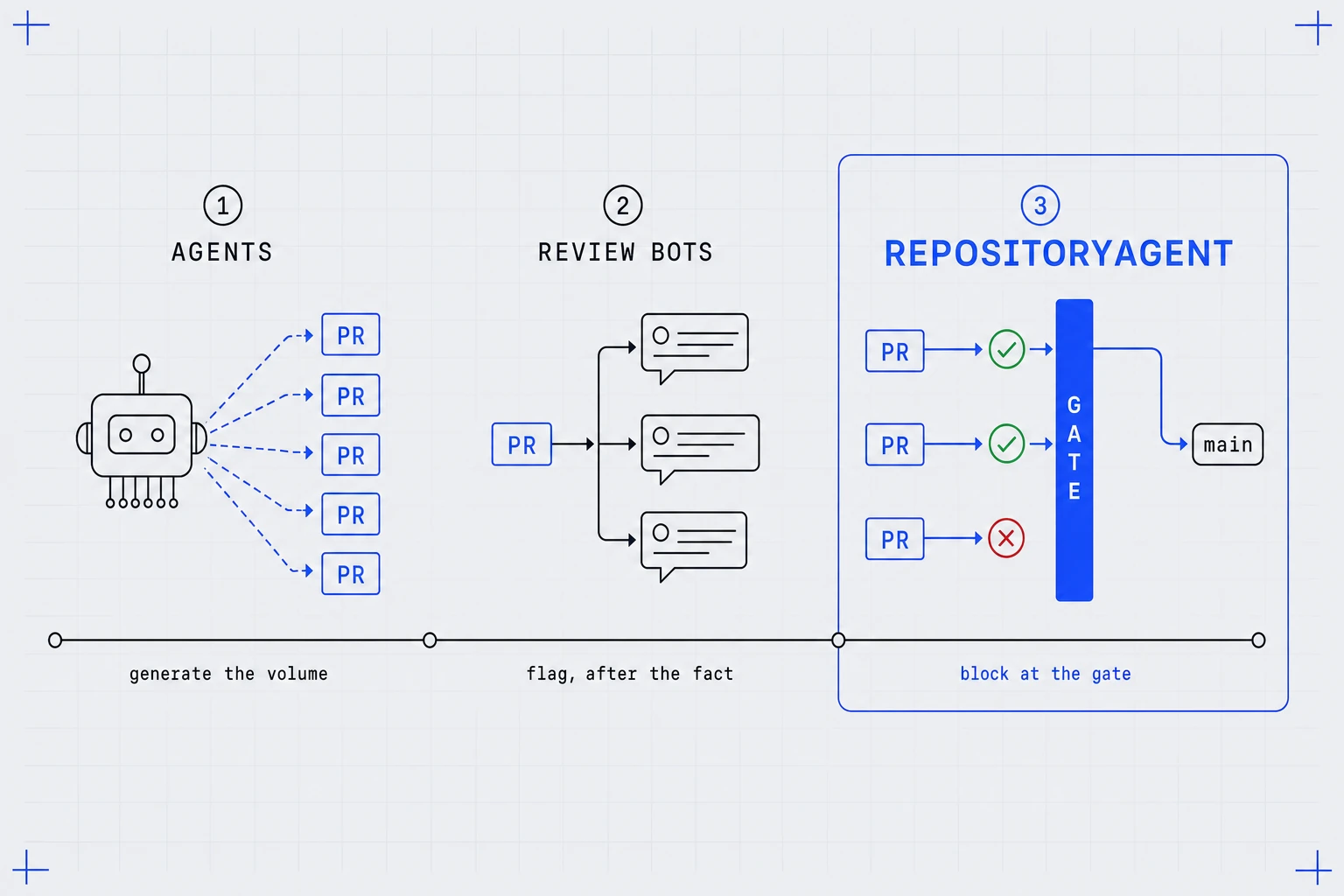
The market sells tools on both sides of the problem — agents that generate the volume, and review bots that flag it after the fact, per seat, forever. Nobody hardens the gate in between. That's the white space.

Three stages: agents generate PR volume, review bots flag issues after the fact, RepositoryAgent blocks bad code at the gate.
agents generate · review bots flag after the fact · RepositoryAgent blocks at the gate
Copilot · Cursor · Devin · Codex

Coding agents

Create the pull-request volume. They're the source of the problem, not the safeguard — and the better they get, the more code hits your gate.

CodeRabbit · Greptile · Qodo

AI review bots

Flag issues after the agent writes them, as advisory comments billed per seat forever. Useful — but they don't stop a bad pattern from being mergeable.

One-time · done-for-you

RepositoryAgent

Hardens the gate every commit flows through, so anti-patterns can't merge in the first place. A fixed-fee engagement — not a subscription, not another seat.

// the category is real — Codacy now ships “Guardrails” for AI code. We don't sell a product to configure; we harden the pipeline you already own.

The offer

Agent-Ready Repo Sprint

In 7 business days we make your repository ready for AI coding agents: enforced gates, deterministic instructions, agent profiles, safe task boundaries, and a benchmark showing exactly what agents can and can't safely do. We ship actual PRs — not a PDF.

01
Agent-readiness benchmarkRun 3–5 representative agent tasks. Score completion, test pass rate, review burden, hallucinated files, command failures, token/cost waste, and unsafe behavior — before vs. after.
02
Pipeline as guardrailTurn your conventions into enforced checks — pre-commit hooks, lint/type/SAST rules, architecture-boundary tests, coverage and branch-protection gates — so anti-patterns fail CI instead of reaching review.
03
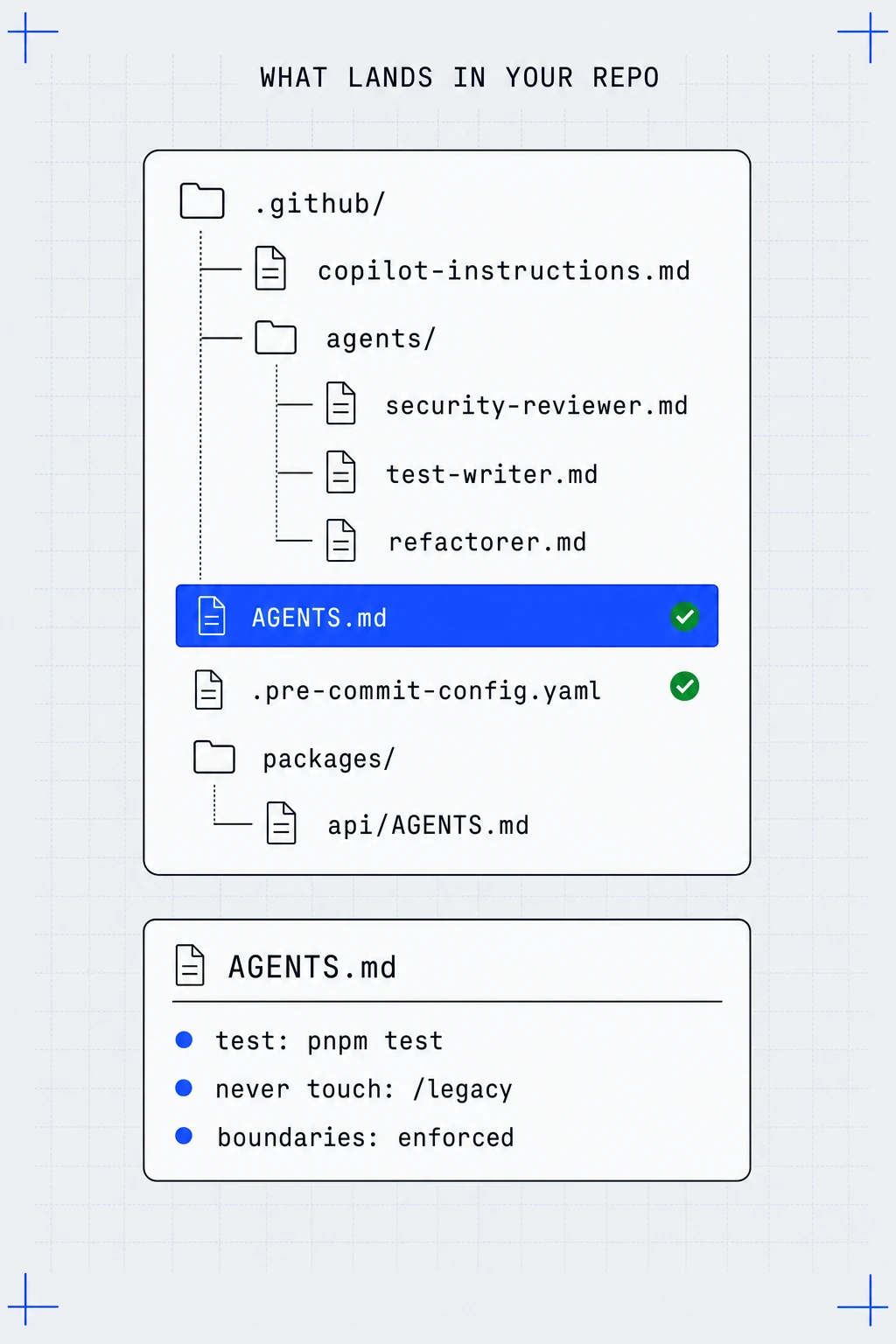
Repo instruction layerRoot AGENTS.md, nested overrides for key packages, CLAUDE.md / Cursor rules / Codex guidance, and .github/copilot-instructions.md.
04
Custom agent profiles.github/agents/*.md profiles — security-reviewer, test-writer, refactorer — with prompts, tools, and MCP config.
05
Agent-safe command mapExact install, test, lint, typecheck, build commands. Known flaky tests, “do not run” commands, “never touch” directories, env requirements.
06
Agent task taxonomySafe for agents · needs human review · do not delegate · ideal backlog candidates.
07
Issue & PR templatesAcceptance criteria, required tests, review checklist, rollback notes, and security/privacy flags for agent-authored work.
08
Engineering debrief60–90 min with your CTO / VP Eng / leads: what changed, which workflows are now safe, which remain unsafe.
Repository file tree showing AGENTS.md, .github/agents profiles, copilot-instructions.md and pre-commit config added to the repo, with an AGENTS.md preview.
real files, committed to your repo
The wedge

It starts with a score

A local-first CLI scans your repo across ten dimensions of agent readiness and prints a scorecard. No source leaves your machine.

repositoryagent audit — ./acme-platform
$ repositoryagent audit

RepositoryAgent · scanning ./acme-platform (monorepo, 14 packages)

   Instruction coverage        32 / 100  no root AGENTS.md, 2 of 14 pkgs documented
   Test determinism            54 / 100  3 flaky suites, test cmd undocumented
   Build determinism           61 / 100
   Agent-safe task boundaries  18 / 100  no "do not touch" zones defined
   Documentation consistency   40 / 100  README and CONTRIBUTING conflict
   Secret / privacy risk       70 / 100
   CI usability                82 / 100
   Enforced quality gates      24 / 100  conventions documented, not enforced in CI
   Package boundary clarity    29 / 100
   Review burden               35 / 100  est. 2.4 review cycles per agent PR
   Estimated agent cost waste  ~41%     tokens on failed / repeated runs

  AGENT READINESS SCORE  42 / 100  — Not agent-ready

  wrote repository-agent-score.json
  wrote report.md · 11 draft instruction files in ./.agent-ready/

$ _
How it works

From audit to shipped PRs

Paid audit · 48h

We run the readiness scan and 3 agent benchmark tasks on one repo, then hand you a scorecard and the exact PRs we'd ship. Credited toward a sprint if you buy within 14 days.

Repo sprint · 7 days

We harden the pipeline into enforced gates, then ship the instruction layer, agent profiles, command map, and templates as real pull requests — and re-run the benchmark to prove the lift.

Debrief & retainer

We walk your leadership through what changed and what's now safe. An optional monthly retainer keeps instructions, profiles, and benchmarks fresh as agents and tools evolve.

Pricing

Fixed price. Shipped PRs. No per-seat tax.

The benchmark guarantee: the sprint ships with a before/after agent benchmark. If it doesn't show a measurable improvement in agent-readiness, we keep working at no charge until it does — or refund the sprint fee. The number is the contract.

Paid Repo Audit
$2,500
48h · one repo
  • Agent readiness scorecard
  • 3 agent benchmark tasks
  • The exact PRs we'd ship
  • 30–45 min debrief
  • Credited toward a sprint
Start here
Most popular
Agent-Ready Sprint
$15,000
7 days · one repo
  • PRs shipped, not a PDF
  • Enforced CI gates
  • Full instruction layer
  • Agent profiles
  • Before/after benchmark
  • Team debrief
Book the sprint
Monorepo
$25,000
10 days
  • Nested instructions
  • Package / service boundaries
  • Multiple agent profiles
  • CI / test hardening plan
Talk to us
Enterprise pilot
$50,000
3–5 repos
  • Org-level custom agents
  • Governance layer
  • Security boundaries
  • Rollout plan + readout
Talk to us
Founding-customer offer: the first 3 customers get the sprint at $7,500–$10,000 for a testimonial, anonymized case study, and permission to use before/after metrics. After that, $15k minimum.  ·  Maintenance retainer available at $5,000/mo.
Who this is for

10–150 engineers, already using agents

Venture-backed or profitable B2B SaaS teams who already approved AI coding tools and now need ROI, fewer regressions, and less review drag.

CTOs & VPs of Engineering Founder-led SaaS teams AI / devtool / infra startups Engineering consultancies using agents Companies with monorepos Complex TS / Python / Rust / Go codebases

// not a fit: solo devs, hobby projects, and tiny teams wanting a $19/mo tool.

Your repo may not be ready for coding agents.

Let's find out in 48 hours. One fixed-price audit: a scorecard, a before/after agent benchmark, and the exact PRs we'd ship to fix it.